Semi-Solid Testing Equipment in Egypt | USP <1724> Pharmaceutical Testing
Choose reliable semi-solid testing equipment in Egypt for creams, ointments, gels, lotions, pastes and other topical pharmaceutical formulations.
Gemicatech supplies vertical diffusion cell testing systems for in-vitro release testing, formulation development, skin-permeation studies and pharmaceutical quality control.
Looking for semi-solid testing equipment?
Send us your product type, applicable test method, sample volume, expected workload and laboratory location. Our team can help you select the right pharmaceutical semi-solid testing system .
Request the Best Price Talk to an Expert Build Your QC LabArticle Sections
| Section | What You Will Learn |
|---|---|
| What Is Semi-Solid Testing? | The purpose of testing creams, gels, ointments and topical products. |
| USP <1724> Testing | How USP <1724> supports semisolid performance testing. |
| Vertical Diffusion Cell Testing | How a vertical diffusion cell measures drug release and permeation. |
| HDT 1000 Test System | The main features of the Copley HDT 1000 system. |
| Pharmaceutical Applications | Where semi-solid testing equipment is used. |
| Buying Guide | The specifications to review before purchasing. |
| Pharmaceutical QC Workflow | How semi-solid testing fits into product development and QC. |
| FAQ | Answers to common technical and purchasing questions. |
What Is Semi-Solid Testing?
Semi-solid testing evaluates the performance of topical and semi-solid pharmaceutical products such as creams, ointments, gels, lotions, pastes and foams.
These products may require in-vitro testing to evaluate drug release, diffusion, permeation or other performance characteristics. The selected method depends on the formulation, product specification and purpose of the study.
A semi-solid testing system can help pharmaceutical laboratories compare formulations, study release profiles and support product development.
Topical Formulations
Evaluate creams, ointments, gels, lotions and other products applied to the skin.
Drug Release Studies
Monitor the movement of an active ingredient from a formulation into a receptor medium.
Pharmaceutical Development
Compare formulations and support in-vitro method development.
USP <1724> Semi-Solid Performance Testing
USP <1724> provides general information for developing in-vitro performance tests for semisolid and liquid-based dosage forms, including creams, gels, ointments, pastes, suspensions, lotions and foams. [326][327]
The chapter discusses equipment and approaches that may be used to evaluate drug release or skin permeation from topical and transdermal products.
Vertical Diffusion Cell Testing
A vertical diffusion cell separates a donor compartment from a receptor compartment using a membrane or suitable support.
The semi-solid formulation is placed in the donor area. The active ingredient then diffuses through the membrane into the receptor medium, where samples can be collected and analyzed at defined time points.
Vertical diffusion cells are commonly used for in-vitro release testing and in-vitro permeation studies of topical pharmaceutical products.
Typical Test Components
- Donor compartment: Holds the cream, gel, ointment or other test formulation.
- Membrane: Separates the formulation from the receptor medium.
- Receptor compartment: Contains the medium into which the active ingredient diffuses.
- Temperature control: Maintains the required test temperature.
- Magnetic stirring: Helps maintain consistent receptor-medium conditions.
- Sampling system: Allows samples to be removed at defined time points.
Copley HDT 1000 Vertical Diffusion Cell System
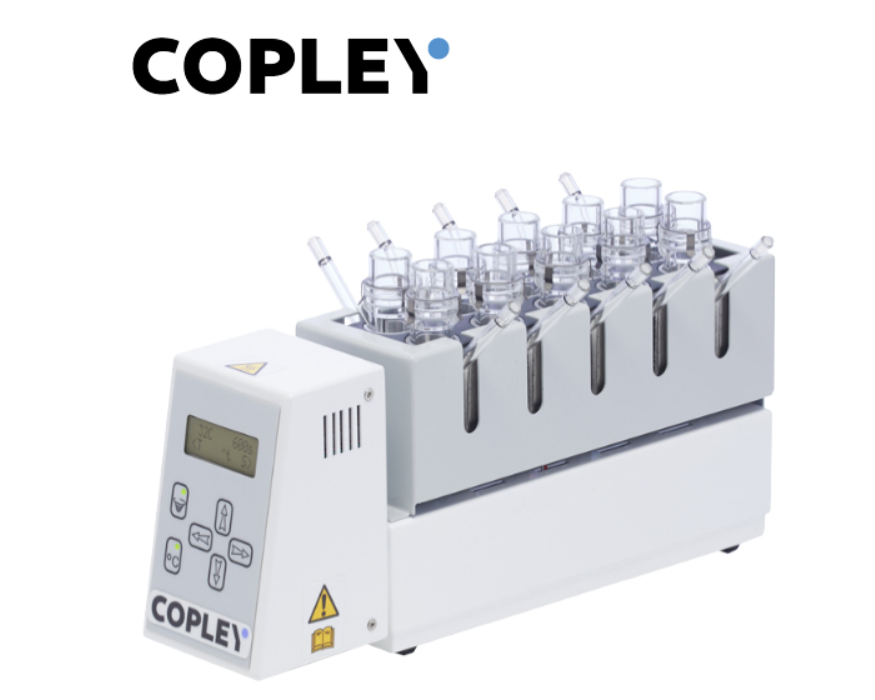
The Copley HDT 1000 is a dry-heat vertical diffusion cell testing system designed for semi-solid pharmaceutical testing and topical formulation studies.
The system supports up to 10 vertical diffusion cells and is designed for controlled temperature and stirring conditions. It supports cell types B, C and skin, with endpoint, discrete and fully automatic sampling compatibility. [329][332]
| Feature | HDT 1000 Capability | Laboratory Benefit |
|---|---|---|
| Test type | Vertical diffusion cell testing. | Supports semi-solid release and permeation studies. |
| Pharmacopoeial reference | USP <1724>. | Supports applicable semisolid performance-test workflows. |
| Cell capacity | Up to 10 vertical diffusion cells. | Supports parallel testing and formulation comparison. |
| Heating system | Dry heating block. | Provides controlled temperature conditions. |
| Cell types | Types B, C and skin. | Supports different semisolid and permeation study configurations. |
| Sampling | Endpoint, discrete and fully automatic options. | Supports different laboratory workflows. |
The exact configuration should be selected according to the product, membrane, receptor medium, test objective, sampling plan and laboratory procedure.
Pharmaceutical Applications
Semi-solid testing equipment supports several stages of pharmaceutical research, development and quality control.
- Formulation development: Compare creams, ointments, gels and other topical formulations.
- In-vitro release testing: Study the rate and amount of active ingredient released from the product.
- In-vitro permeation testing: Evaluate the movement of an active ingredient across a membrane or skin model.
- Generic product development: Compare formulation performance during development.
- Stability studies: Monitor changes in release or permeation behavior over time.
- Batch comparison: Identify performance differences between manufacturing batches.
- Method development: Establish suitable sampling, membrane and receptor-medium conditions.
In-Vitro Release Testing and In-Vitro Permeation Testing
In-vitro release testing focuses on the movement of the active ingredient from the formulation into a receptor medium.
In-vitro permeation testing evaluates the movement of the active ingredient across a membrane or skin model under defined experimental conditions.
| Study Type | Main Purpose | Typical Considerations |
|---|---|---|
| IVRT | Evaluate release of the active ingredient from a formulation. | Receptor medium, membrane, temperature and sampling schedule. |
| IVPT | Evaluate permeation through a membrane or skin model. | Skin or membrane preparation, temperature and permeation conditions. |
| Comparative Study | Compare formulations or batches. | Consistent sample preparation and validated data analysis. |
How to Choose Semi-Solid Testing Equipment in Egypt
Define the Product Type
Identify whether the laboratory will test creams, ointments, gels, lotions, pastes, foams or another topical formulation.
Define the Test Objective
Decide whether the primary objective is in-vitro release, in-vitro permeation, formulation comparison, stability testing or method development.
Review the Applicable Method
Confirm the relevant USP, Ph. Eur. or internal procedure and identify its requirements for cells, membrane, temperature, receptor medium, stirring and sampling.
Check Cell Capacity
A single-cell system may be suitable for introductory work, while a system supporting multiple cells can improve throughput and formulation comparison.
Evaluate Temperature and Stirring
Confirm how temperature is controlled and how the receptor medium is stirred. Repeatable conditions are important for reliable comparisons.
Review Sampling Options
Ask whether the system supports endpoint, discrete or automated sampling and whether the configuration suits your laboratory workflow.
Ask About Support in Egypt
Confirm delivery, installation, operator training, method support, qualification, maintenance, spare parts and after-sales service.
| Selection Factor | Why It Matters | Question for the Supplier |
|---|---|---|
| Formulation Type | Determines the suitable cell, membrane and sample preparation. | Is the system suitable for creams, gels, ointments or lotions? |
| Test Objective | Defines whether IVRT, IVPT or comparative testing is required. | Which release and permeation studies can the system support? |
| Cell Capacity | Affects throughput and parallel formulation comparison. | How many diffusion cells can be operated at the same time? |
| Temperature Control | Supports repeatable release and permeation conditions. | How is the test temperature controlled and monitored? |
| Sampling | Determines how receptor-medium samples are collected. | Are endpoint, discrete and automatic sampling options available? |
| Service | Helps maintain performance and reduce laboratory downtime. | Is technical support available in Egypt? |
Semi-Solid Testing in the Pharmaceutical QC Workflow
Semi-solid testing is one part of a broader pharmaceutical development and quality-control program. Depending on the product, laboratories may also evaluate assay, content uniformity, viscosity, pH, microbial quality, physical appearance and stability.
For related pharmaceutical testing, visit Suppository Tester and pH Meters .
For tablet and powder testing equipment, visit Tablet Friability Tester , Tap Density Tester , Tablet Hardness Testers and Tablet Dissolution Tester DIS-Series .
Common Mistakes When Buying Semi-Solid Testing Equipment
- Choosing equipment without defining the formulation type.
- Confusing in-vitro release testing with in-vitro permeation testing.
- Ignoring membrane, receptor-medium and temperature requirements.
- Selecting a single-cell system when parallel testing is required.
- Failing to confirm sampling and automation options.
- Ignoring the need for controlled stirring and temperature.
- Purchasing equipment without checking the applicable USP or internal method.
- Focusing only on the purchase price without considering service and qualification support.
Why Buy Semi-Solid Testing Equipment from Gemicatech?
Gemicatech supplies semi-solid testing equipment in Egypt for pharmaceutical development, research and quality-control laboratories.
- Support for pharmaceutical R&D and QC laboratories.
- Guidance on vertical diffusion cell testing systems.
- Support for cream, gel, ointment and topical formulation testing.
- Quotation support based on your product and test procedure.
- Delivery and installation coordination in Egypt.
- Operator guidance and after-sales service.
Explore our Pharmaceutical Industry Solutions and Laboratory Testing Equipment .
Related Pharmaceutical Testing Products
Frequently Asked Questions
What Is Semi-Solid Testing?
Semi-solid testing evaluates the performance of creams, ointments, gels, lotions, pastes and other topical pharmaceutical formulations.
What Is a Vertical Diffusion Cell?
A vertical diffusion cell separates a donor formulation from a receptor medium using a membrane or support and allows the laboratory to evaluate drug release or permeation.
What Is USP <1724>?
USP <1724> provides general information about performance testing of semisolid drug products, including in-vitro release and permeation studies.
What Is the Difference Between IVRT and IVPT?
IVRT evaluates release of an active ingredient from a formulation, while IVPT evaluates permeation across a membrane or skin model.
How Many Cells Does the HDT 1000 Support?
The HDT 1000 supports up to 10 vertical diffusion cells, depending on the selected configuration.
Can Gemicatech Supply Semi-Solid Testing Equipment in Egypt?
Yes. Gemicatech supplies semi-solid testing equipment in Egypt and can support product selection, quotation, delivery coordination and after-sales service.
Buy Semi-Solid Testing Equipment in Egypt
Send your formulation type, applicable USP or internal procedure, test objective, expected sample volume and data requirements. Get professional guidance and the best available quotation for a pharmaceutical semi-solid testing system in Egypt .
Request the Best Price Contact on WhatsApp After-Sales Support